 English
 اللغة العربية
 বাংলা
 Deutsch
 Français
 Bahasa Indonesia
 Русский алфавит
 Español
 اردو
 Português
 Türkçe
 Tiếng Việt


How the Felt Is Built
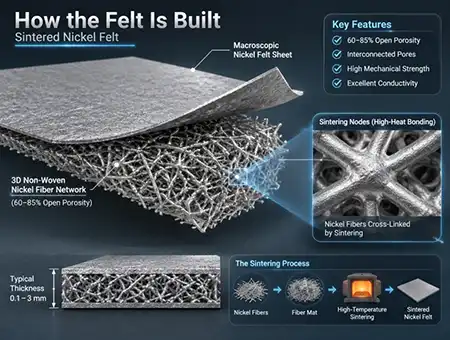
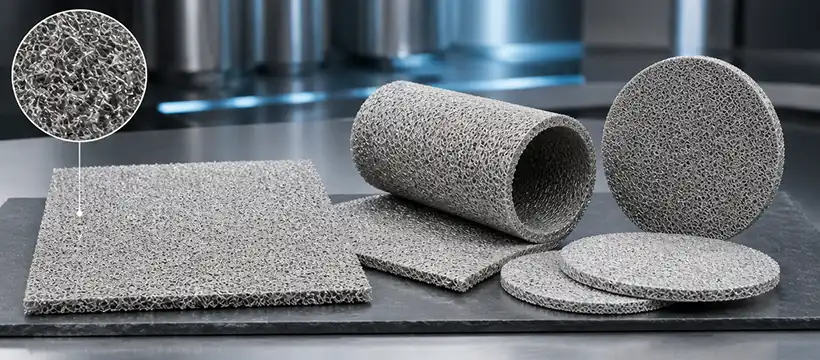
Nickel filament of 6 to 100 microns is dispersed in a carrier, laid onto a moving belt and dewatered to form a mat of controlled areal weight. Dry-laid lines do the same job with an air stream and a vacuum box. Both routes end with a calendered sheet of even density, which matters because a thickness variation of a few percent shows up later as a pressure-drop hot spot.
The mat then passes through a vacuum or hydrogen furnace at 1,000 to 1,200 Celsius. At that temperature the filaments do not melt; they diffuse at contact points and grow necks. Longer dwell or a higher set point builds thicker necks, raising tensile strength and lowering flexibility, while a short cycle leaves a springy sheet with finer pores.
Cooling is controlled rather than quenched. Uneven cooling leaves residual stress that curls a 1 mm sheet and makes disc cutting inaccurate, so the load is usually held under a weighted plate through cool-down.
Pore Structure and Permeability
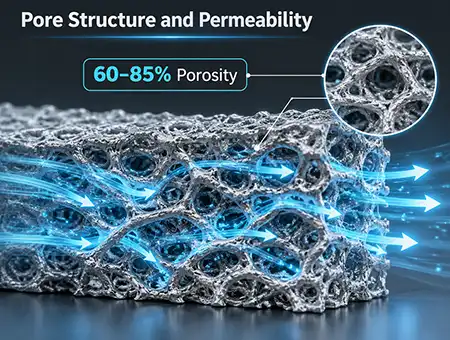
A woven mesh has one pore size and a fixed open area. Felt does not. The same 0.5 mm sheet can be produced at 60 percent porosity with 5 micron passages or at 85 percent with 40 micron passages, simply by changing fibre diameter and press density.
Permeability follows that pore network. Published figures run from roughly 400 to 1,600 litres per minute per square decimetre at standard test pressure, and the useful comparison is always at equal thickness and equal rating rather than at equal weight.
Because the channels twist through the sheet, particles are captured at different depths. A felt element loads from the upstream face inward, which is why reverse-pulse cleaning works far better on felt than on a surface screen.
Heat and Oxidation Limits
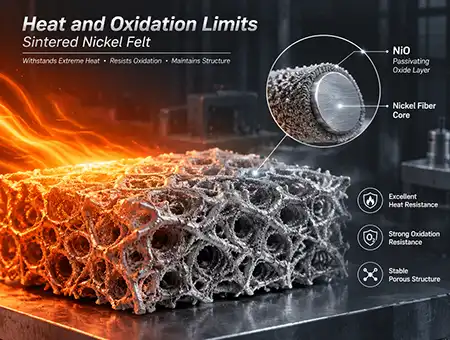
Nickel melts at 1,455 Celsius, but the practical ceiling in air is set by oxidation, not by melting. Continuous service in still air sits around 600 to 700 Celsius for thin felt; above that the fibre surface oxidises, the necks thin out and the sheet turns brittle.
In vacuum, hydrogen or cracked ammonia the limit moves to 900 to 1,200 Celsius, which is why furnace and catalyst duties are quoted in those atmospheres. Sulphur-bearing gases are the exception in either case, because nickel sulphide forms at temperatures well below the oxidation limit and attacks the fibre.
Thermal cycling is a separate question from steady heat. An element that sees twenty to thirty cycles between 400 and 700 Celsius should be specified with a slightly heavier areal weight than a steady-state unit, to absorb the creep that accumulates at the necks.
Chemical Resistance
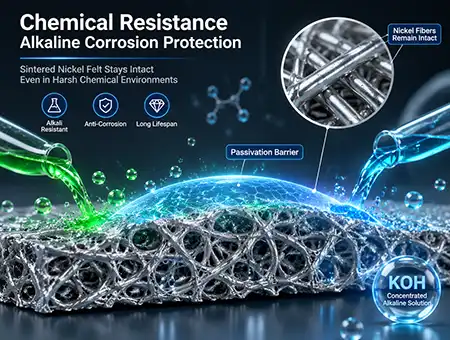
Nickel behaves well in alkaline and neutral media. In potassium hydroxide at 30 percent and 80 Celsius the surface forms a passive film within minutes and stays stable, which is the basis of its use as an electrode substrate in alkaline electrolysers.
Halide-free organic acids and many salt solutions are also acceptable. The failures to design around are strong mineral acids, chloride-rich brines and wet chlorine, where pitting starts at inclusion sites and perforates a thin sheet quickly.
Where a stainless element would pit in the same duty, felt buys a longer window. Where the duty is genuinely acidic, titanium or 316L felt is the better answer and nickel should not be forced into it.
Strength, Flexibility and Fabrication
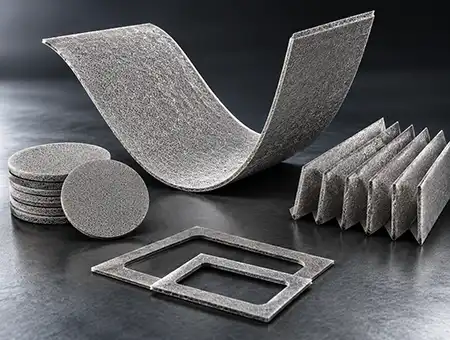
Tensile strength of a sintered nickel felt is typically 5 to 8 megapascals, five to fifty times that of nickel foam of the same thickness. That is enough to hold a disc in a housing under reverse pulse without a support plate.
Thin grades stay flexible enough to wrap round a mandrel. Grades above about 0.8 mm stiffen and are better handled as flat blanks, cut by laser, water jet or die. Welded cylinders are made by rolling the sheet and joining the seam; the weld zone should be re-sintered locally or it becomes the weak point in a pressure cycle.
Cutting tolerance of plus or minus 0.5 mm on diameter is normal, and the edge should be folded or sealed rather than left as a raw cut, otherwise fibres shed into the clean side of the filter.
Filtration Rating and Cleaning

Ratings are quoted either as nominal micron or as bubble-point pore size, and the two are not interchangeable. A felt sold as 10 micron nominal may hold 10 micron glass spheres at 95 percent yet pass a 15 micron fibre, so the test method belongs in the specification.
Cleaning sets the economics. Reverse-pulse air or filtrate backwash removes loose cake; ultrasonic cleaning in a mild detergent lifts particles from the pore throats; burn-off at 400 to 450 Celsius in air removes polymer and carbon at the cost of some oxidation life; caustic circulation suits oil and grease.
Three to five cleaning cycles are realistic for most grades before the clean pressure drop rises by more than 20 percent. That figure, rather than calendar life, is the practical replacement trigger.
Applications by Industry
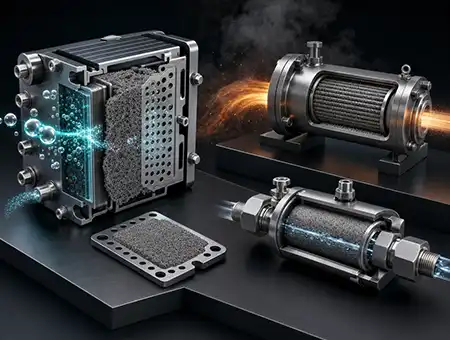
Alkaline and AEM electrolysers use felt as a porous transport layer and electrode substrate: the open structure lets electrolyte reach the catalyst and lets hydrogen or oxygen leave without blinding the electrode.
High-temperature gas duty includes burner media, syngas and exhaust slipstreams where a ceramic candle would crack under thermal shock. Felt survives the shock and can be back-pulsed online.
In polymer processing, nickel felt discs sit in the melt line ahead of the die, catching gel and char at ratings between 10 and 40 micron. Hydraulic and avionics fluid lines use it where a paper element would collapse. Nuclear and pharmaceutical vents use it as a cleanable barrier, and fuel cell work uses the conductivity rather than the filtration: the same sheet serves as gas diffusion layer or current collector.
Specification and Size Selection
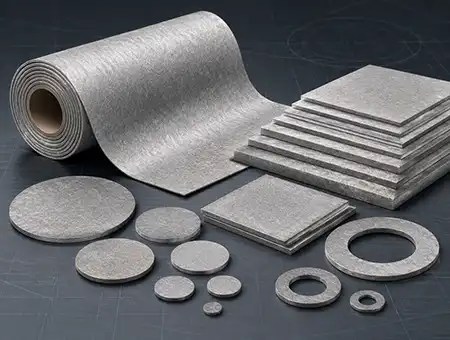
A workable specification names five things: thickness with tolerance, areal weight, porosity, rating with test method, and the cleaning route. Diameter or sheet size follows from the housing; 1,500 by 1,200 mm is a common master sheet, and 1,200 by 1,200 mm covers most disc layouts without waste.
Thickness from 0.1 to 1.5 mm is standard, with plus or minus 0.03 to 0.05 mm on thin grades. Ask for the areal weight that goes with the thickness rather than accepting whatever sheet is in stock, because a 0.5 mm sheet at 450 grams per square metre and one at 1,000 grams behave as different filters.
For a first trial, order discs at two porosities rather than two thicknesses. Porosity changes pressure drop and dirt capacity at the same time, so the result tells you more per test hour.
Sintered nickel felt earns its cost in three situations: heat that destroys polymer cartridges, alkalinity that eats stainless steel, and a need for a conductive porous body that a ceramic cannot provide. Outside those, a pleated paper or stainless mesh element will usually be cheaper per unit of flow and should be the first choice.
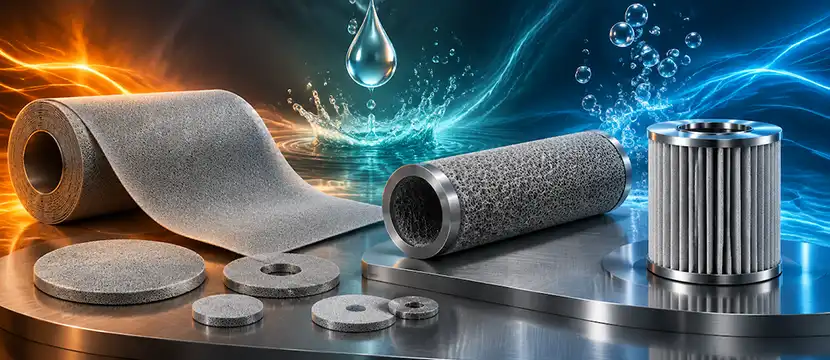
Where felt is the right answer, the design conversation should start with the duty rather than the catalogue. A hydrogen electrolyser stack cares about through-plane conductivity, compression set and bubble release; a burner or exhaust slipstream cares about oxidation allowance at temperature and thermal cycling; a polymer melt line cares about absolute rating and back-flush behaviour. Each pulls thickness, porosity and fibre diameter in a different direction, and one grade rarely serves two of them well.
Two practical points are worth building into a specification. First, ask for porosity and bubble-point pore size together, not one alone; a 70 percent porosity sheet can still be rated at 5 microns or at 40 microns depending on fibre diameter, and the two behave very differently in service. Second, fix the cleaning method before fixing the element format. Caustic wash, ultrasonic, reverse pulse and burn-off each set a limit on how many cycles the sintered bonds will survive, and a supplier who asks about that method before quoting is usually the one who can hold the tolerance later.
On the supply side, rolled sheet, laser-cut discs, welded cylinders and formed cups are all achievable from the same base felt, and small trial quantities are a sensible way to confirm pressure drop and service life before committing to a production run. Treated as an engineered component rather than a commodity screen, a nickel felt element typically outlasts the three or four replacements it displaces.