 English
 اللغة العربية
 বাংলা
বাংলা Deutsch
 Français
 Bahasa Indonesia
 Русский алфавит
 Español
 اردو
اردو Português

Characteristics of Sintered Felt Filter Element
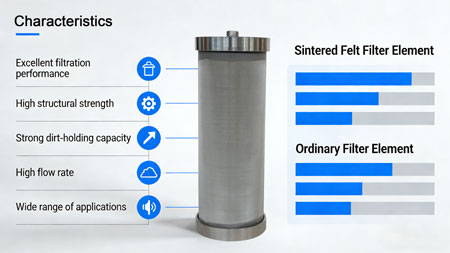
Excellent filtration performance
High structural strength
Strong dirt-holding capacity
High flow rate
Wide range of applications
Classification of Sintered Felt Filter Element
·Classified by shape
Cylindrical: The most common shape, used in pipeline filters, usually divided into structures such as those without wire winding, with wire winding (for increased strength), or with square openings (for specific connectors).
Sheet/Flat: Used for flat filtration requirements, suitable for some specific filtration equipment.
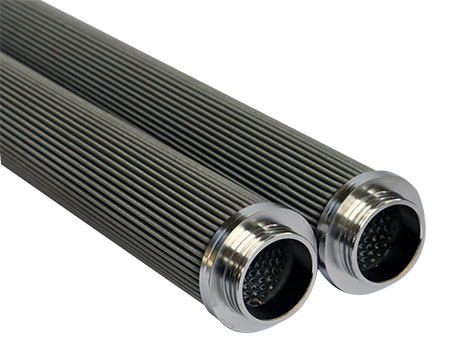
Folded cylindrical: Made by folding sintered felt into a cylindrical shape, significantly increasing filtration efficiency and dirt-holding capacity by increasing the surface area.
Conical/Specially customized irregular shapes: Made into conical or other irregular shapes according to specific equipment interfaces or flow field requirements.
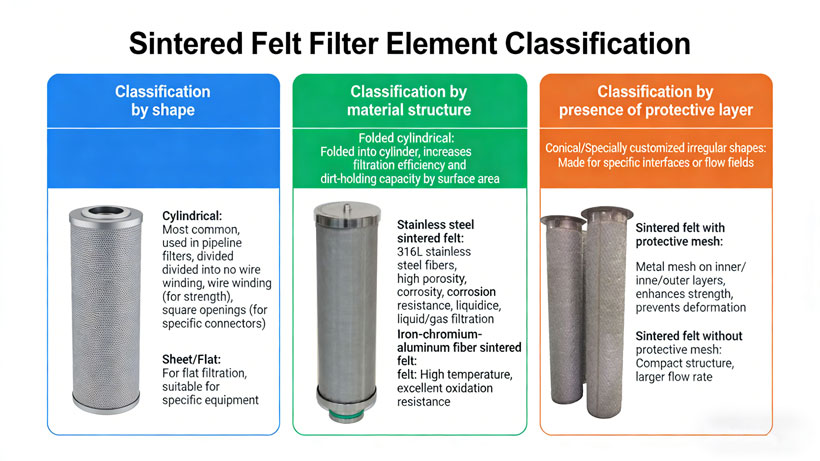
·Classified by material structure
Stainless steel sintered felt filter element: Made of 316L stainless steel fibers sintered at high temperature, with high porosity and strong corrosion resistance, suitable for liquid and gas filtration.
Iron-chromium-aluminum fiber sintered felt filter element: Suitable for higher temperature conditions, with excellent oxidation resistance.
·Classified by the presence or absence of a protective layer
Sintered felt with protective mesh: A metal mesh is added to the inner and outer layers of the filter material to enhance structural strength and prevent deformation.
Sintered felt without protective mesh: Compact structure and relatively larger flow rate.
Application industries of Sintered Felt Filter Element
Polymer materials, petrochemicals, electronics, aerospace, and pharmaceuticals and so on.Stainless vs iron-chromium-aluminum sintered felt filter comparison
· Similarities
Both possess high strength and excellent filtration performance.
· Differences
Material Composition and Structure:
Stainless steel sintered felt filter element: Typically made of 316L or 304 stainless steel fibers, non-woven and vacuum sintered.
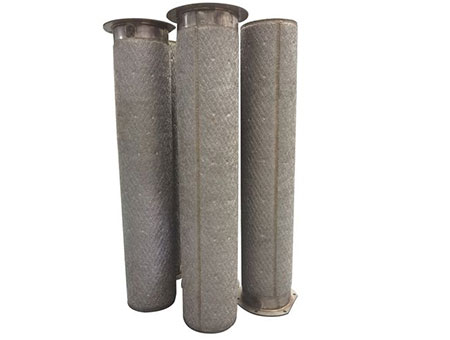
Iron-chromium-aluminum fiber metal sintered felt filter element: Made of iron-chromium-aluminum alloy fibers (containing active metals such as aluminum), with a dense alumina protective film formed on the surface at high temperatures.
Temperature Resistance (Key Difference):
Stainless steel sintered felt filter element: Can operate continuously below 600℃.
Iron-chromium-aluminum fiber metal sintered felt filter element: Extremely high heat resistance, capable of continuous operation in environments above 800℃ to 1000℃, suitable for ultra-high temperature applications.
Corrosion Resistance:
Stainless steel sintered felt filter element: Resistant to general corrosion from organic solvents, acids, and alkalis.
Iron-chromium-aluminum fiber metal sintered felt filter element: Superior to stainless steel, exhibiting extremely strong corrosion resistance in high-temperature sulfidation and oxidation environments, suitable for applications such as flue gas denitrification.
Physical Properties:
Stainless steel sintered felt filter element has good toughness and high strength.
Iron-chromium-aluminum fiber metal sintered felt filter element is lighter in weight, has a smaller coefficient of thermal expansion, and exhibits less deformation at high temperatures (good creep resistance).
Applicable Scenarios of Sintered Felt Filter Element
Stainless steel sintered felt filter elements: used for polymer filtration, chemical filtration, and high-temperature gas dust removal.
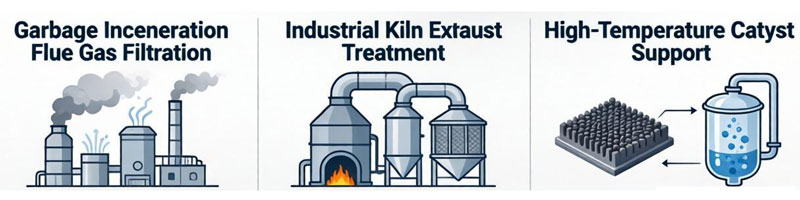
Iron-chromium-aluminum fiber metal sintered felt filter elements: used for waste incineration flue gas filtration, industrial kiln exhaust gas treatment, and high-temperature catalyst carriers.
Based on the information above, we can understand that for industrial filtration in normal temperature, medium-to-high pressure, and general corrosion-resistant environments, stainless steel sintered felt filter elements are recommended. For extremely high temperature and highly corrosive environments, iron-chromium-aluminum fiber metal sintered felt filter elements are the preferred choice.