 English
 اللغة العربية
 বাংলা
বাংলা Deutsch
 Français
 Bahasa Indonesia
 Русский алфавит
 Español
 اردو
اردو Português

Working Principle
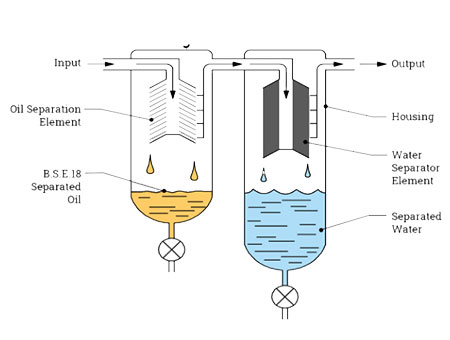
When a mixture of different liquids flows into the separator, it first enters the coalescing filter element. The coalescing filter element has multiplelayers of filter media,and its aperture increases layer by layer.
Due to the difference in surface tension,the oil passes through the filter layer quickly, while the water is much slower, and because the coalescing filter element uses hydrophilic materials, tiny water droplets are adsorbed on the surface of the filter layer, causing the water droplets to coalesce.
Affected by kinetic energy, small droplets race through the small holes and gradually merge into large droplets, and settle under the action of gravity to separate from the oil, After passing through the coalescence filter, there are still smaller water droplets moving forward to the separation filter element due to inertia effect. The separation filter element is made of a special hydrophobic material. when the oil passes through the separation filter element, the water droplets are blocked outside, and the oil passes through the separation filter element and is discharged from the outlet.
Two process stages
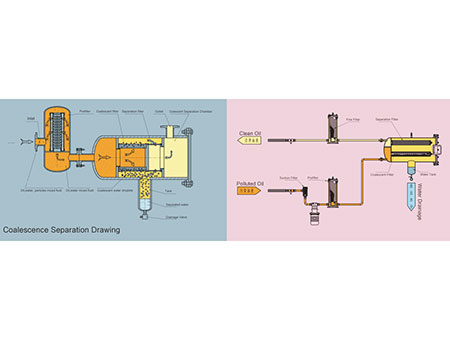
Coalescence stage: The oil first passes through a hydrophilic coalescing filter, where tiny water droplets are adsorbed and aggregated into larger droplets, which then undergo initial sedimentation separation under gravity.
Separation stage: The remaining small water droplets enter the hydrophobic separation filter core along with the oil; the water droplets are retained outside the filter core, while the oil flows through unimpeded, achieving complete separation of oil and water.
Coalescence Dehydration Oil Purifier
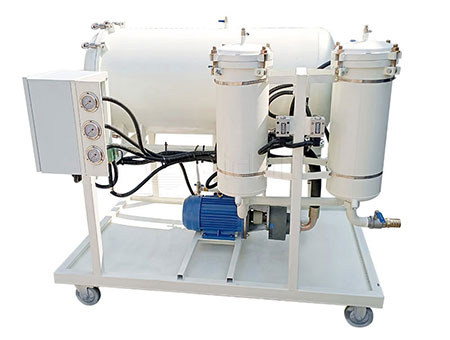
1.Coalescence system
The coalescence system consists of a group of coalescence filter elements. The coalescence filter elements adopt a unique polar molecular structure. The free water and emulsified water in the oil are coalesced into larger water droplets after passing through the filter elements. These droplets then sink under the influence of gravity and are collected in the water storage tank.
2.Separation system
It uses special hydrophobic materials for the separation filter element to block water droplets in the oil and cause them to coalesce and settle in the water storage tank, achieving oil-water separation.
3.Drainage system
It can be manually drained, or an oil-water interface sensor can be installed for automatic drainage, supporting unmanned operation.
4.Particle filtration system
High-efficiency filter material + large-sized filter cotton design, capable of filtering out fine particles and impurities; it can be used alone or combined with the coalescence system to achieve integrated filtration and water separation.
Application Industries
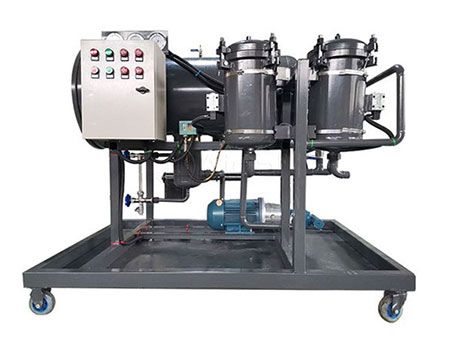
1.Power industry (main application scenarios)
(1)Substations, power plants: Dehydration of transformer oil, transformer insulation oil, switch oil to remove emulsified water and impurities, improving insulation performance and preventing discharge breakdown;
(2)Steam turbine generator sets: Online bypass filtration of turbine oil and lubricating oil to remove system condensate water and rusting impurities, protecting bearing shells and speed control systems;
(3)Wind power / solar power stations: Outdoor purification of wind turbine gearbox lubricating oil and hydraulic oil from water ingress.
2. Fuel storage and transportation, gas stations, oil depots industry
(1)Diesel storage tanks, kerosene storage tanks, oil tankers: Removal of free water and emulsified water from diesel, aviation kerosene, and marine fuel oil;
(2) Gas stations, oil supply stations for construction machinery: Purification of fuel to prevent rusting of fuel injectors, wear of plungers, and combustion failures;
(3) Aviation fuel depots: Precise dehydration and impurity removal of aviation kerosene to meet aviation fuel cleanliness standards.
3. Shipping and transportation industry
(1) Inland river vessels, ocean-going cargo ships, engineering ships: Oil water separation for marine diesel, main engine lubricating oil, and steering hydraulic oil;
(2) Oil supply piers, ship refueling systems: Online circulating filtration of fuel to reduce problems of water accumulation and emulsification in the bottom of tanks.
4. Mining, construction machinery, infrastructure industry
Hydraulic oil and diesel purification for equipment such as excavators, loaders, shield machines, cranes, and road rollers; Outdoor operating equipment is prone to water ingress and emulsification, and the coalescence equipment can be moved quickly and efficiently for dehydration and impurity removal on-site.
Differences between oil purifiers
1.Core Working Principle Differences
(1)Coalescence Dehydration Oil Filter
It relies on hydrophilic coalescing filter elements and hydrophobic separation filter elements to physically break down the emulsion. It utilizes the surface tension difference between oil and water to coalesce small water droplets into larger water droplets for gravity sedimentation. It operates at normal temperature without heating or vacuum. It is a purely physical filtration and separation process.
(2) Vacuum Oil Filter
It relies on heating and high vacuum negative pressure to lower the boiling point of water. The water in the oil vaporizes and is separated through a condenser.It is combined with precision filter screens to remove impurities and undergo high-temperature vacuum evaporation for dehydration.
2.Post-treatment moisture content
(1)Coalescence Dehydration Oil Filter is ≤100ppm
(2)Vacuum Oil Filter is 5-30ppm
3.Is heating required?
Coalescence Dehydration Oil Filter is operates at normal temperature without heating. Vacuum Oil Filter must be heated (at 40 to 65℃)
Advantages
It integrates dual functions of fine filtration and coalescing separation, featuring high dehydration efficiency and reliable performance. It is particularly suitable for removing large volumes of water contained in oil and boasts unique advantages unavailable with vacuum or centrifugal purification technologies. The equipment thoroughly breaks all oil-water emulsified structures via its multi-stage particle filter system, enabling stable control of oil cleanliness to meet standard system requirements.
This unit will not alter the physical and chemical properties of treated oil, effectively extending oil service life. It also delivers prominent merits including low energy consumption, minimal running costs and superior overall configuration. With stable continuous operation capability, the machine is perfectly adapted for long-term online purification work.
The coalescence dehydration oil purifier is an ideal oil-water separation and impurity filtration device for diesel, turbine oil, hydraulic oil and transformer oil. With full-physical room-temperature purification, easy operation and low maintenance cost, it solves the common emulsification and water ingress problems of industrial oil efficiently. It is a cost-effective purification device matching modern industrial fuel and lubrication management, bringing stable and economic oil treatment guarantee for all major industries.